Introduction to Spanning Tree Protocol
Modern enterprise networks often use redundant links between switches to improve availability and prevent network outages. While redundancy increases reliability, it can also create Layer 2 loops that lead to serious network problems such as broadcast storms, MAC address table instability, and excessive bandwidth consumption.
Spanning Tree Protocol (STP) was developed to solve this problem by identifying redundant paths and automatically blocking unnecessary links while keeping them available as backup paths.
What is a Layer 2 Bridging Loop?
A Layer 2 bridging loop occurs when multiple active paths exist between switches and there is no loop prevention mechanism in place. Ethernet frames do not contain a Time-To-Live (TTL) field, which means a frame can circulate indefinitely between switches once a loop is created.
In networks with redundant connections, a broadcast frame can continuously travel between switches, consuming bandwidth and creating instability throughout the network.
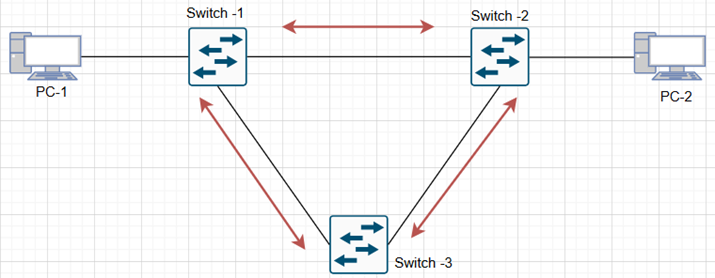
Impact of Layer 2 Loops
Consider a scenario where PC1 sends a broadcast frame into the network. If multiple switches are connected through redundant paths without STP enabled, the frame may continuously circulate between switches.
- Broadcast storms
- Excessive bandwidth utilization
- High CPU usage on switches
- MAC address table instability
- Network performance degradation
- Complete network outage
Methods to Prevent Layer 2 Loops
1. Use a Single Path
Using only one physical link between switches eliminates loops but removes redundancy. If the link fails, connectivity is lost.
2. Manually Disable Redundant Links
Administrators can manually shut down backup links and enable them during failures. However, this requires manual intervention and is not suitable for modern enterprise environments.
3. Use Spanning Tree Protocol (Recommended)
Spanning Tree Protocol automatically blocks redundant links while keeping them available as backup paths. If the active path fails, STP automatically activates the backup path.
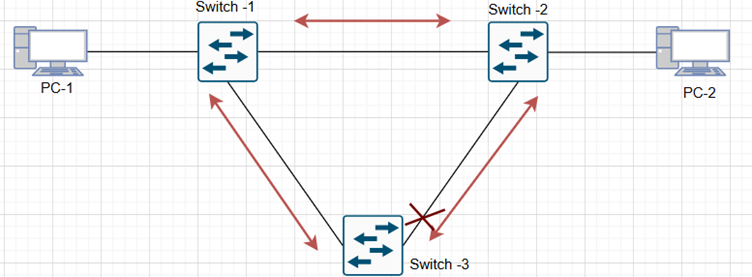
In this topology, the link between Switch-2 and Switch-3 is placed into a blocking state by STP. Traffic uses the forwarding path while the blocked link remains available for failover.
How Spanning Tree Protocol Works
STP builds a loop-free logical topology by placing switch ports into either a forwarding state or a blocking state.
- Forwarding Ports – Actively forward traffic.
- Blocking Ports – Prevent loops by not forwarding traffic.
Only one active path exists between network segments. If the forwarding path fails, STP recalculates the topology and activates an alternate path.
Ask Your Doubt